


Photo courtesy of Gulfport History Museum
In the March election, Gulfport voters cast their ballots for an all-female council. This historic election marks the first time that women comprise all elected municipal officials in Gulfport. Michael Fridovich served Ward IV in an appointed capacity, finishing the term of Ian O’Hara after his resignation on Nov. 19, 2024.
Nearly 70 years ago, another woman who pioneered politics and public safety in Gulfport passed away. Edna Christman, a Gulfport resident for approximately 14 years, became the first female staff member of the Gulfport Police Department (GPD) and served a two-year term on the city council.
Christman died in Houston, Texas, on April 23, 1955, at the age of 74. She had moved to Texas less than two years earlier to be in her daughter’s care. Despite her previous civic leadership in Gulfport, Christman’s Texas death certificate simply listed her as a “domestic” and “housewife.”
Pioneer Policing and Politics
Few women served as police officers in Florida before the 1970s. Prior to that, most women employed by law enforcement agencies held clerical positions, worked as uniformed “matrons” who supervised female inmates, or enforced parking rules (and were known, disparagingly, as “meter maids”).
The segregation of police duties by gender resembled similar restrictions based upon race. When St. Petersburg and other large Florida cities finally hired Black police officers, the men who originally served in those roles had patrols and arrest powers limited to the Black community.
This trend in police staffing resembled the lack of women who won elective office before that time. Prior to the ratification of the 19th Amendment in August 1920, laws and customs prohibited most women from voting and largely excluded them from direct political participation.
Beginning in the late 1800s, organizations such as the General Federation of Women’s Clubs advocated for women who could not vote. Local chapters lobbied for educational reform, literacy, community improvement, and public safety before Florida women could cast ballots.
Breaking Barriers
George M. Coslick, St. Petersburg’s police chief during the early 1920s, hired Ethel Larabee as that city’s first female officer in November 1924. Larabee regularly participated in detective work and apprehended male suspects while with the agency.
Each county has constitutional officers mandated by Florida’s constitution. These include the sheriff, tax collector, supervisor of elections, and the clerk of the circuit court, among other offices stipulated in the state’s constitution.
Myrtle B. O’Quinn became Pinellas County’s first female constitutional officer. Gov. David Sholtz appointed her to fulfill her husband’s unexpired term as the clerk of the circuit court. Karl B. O’Quinn had served from 1925 until his death in April 1936. She completed his term as interim clerk in 1936.
Archie G. McQuagge succeeded Myrtle O’Quinn in 1937. After Archie’s death in December 1937, Gov. Fred Cone appointed his widow, Laura Jane McQuagge, to serve for a few weeks as interim clerk of the circuit court before appointing a man to continue in this role.
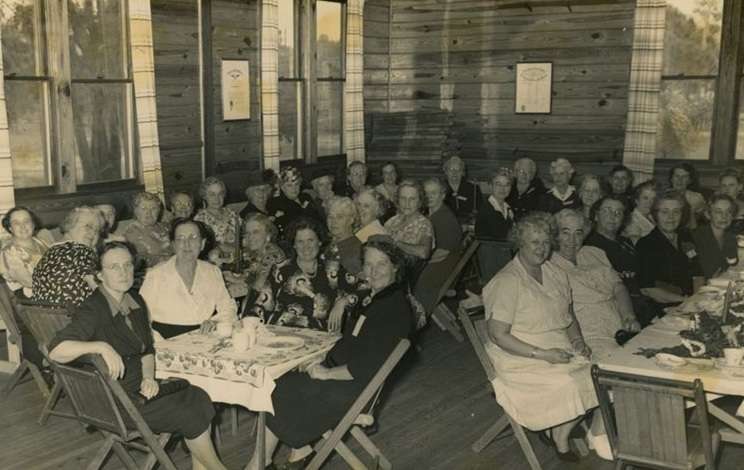
Photo courtesy of Gulfport Arts & Heritage
Officer Christman
According to the Gulfport Police Department’s website, Veronica Lumsden became Gulfport’s first female police officer when hired in 1982. However, Christman joined GPD four decades earlier. Mayor Andrew W. Gibson appointed her as a volunteer in 1942.
Although unpaid, Christman assumed many duties as Gulfport’s original policewoman. Christman supervised activities along Gulfport Beach, including the oversight of unattended children. She served in this role for more than a decade. During World War II, she also watched the coastline as an airplane spotter.
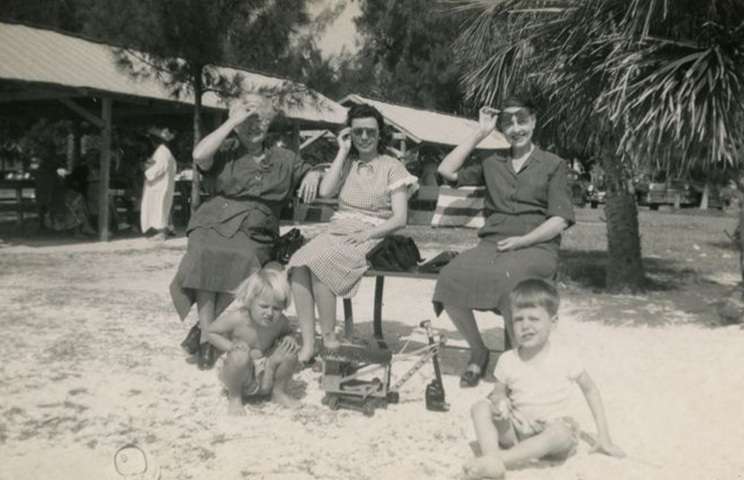
Photo courtesy of Gulfport Arts & Heritage
Born Edna Rhiel Hulshizer on Feb. 17, 1881, she spent her childhood in Omaha, Nebraska. She later moved with her parents to Joliet, Illinois. She exchanged vows with Halstead Ellis Christman at a ceremony in St. Joseph, Michigan, in April 1909.
Her husband worked as an auditor in coal company offices in Cincinnati, Ohio, and Knoxville, Tennessee. By 1940, Edna moved to Gulfport and shared a home on 25th Avenue South with her mother, two adult daughters, and a grandchild. Her husband occasionally worked in Knoxville until retiring in 1946.
During her time in Gulfport, Edna became an early member of the Home Demonstration Club. She also joined the Community Club and the Gulfport Garden and Bird Club. She took on a leadership role with the Gulfport War Chest fundraising effort in early 1945, during the closing months of World War II.
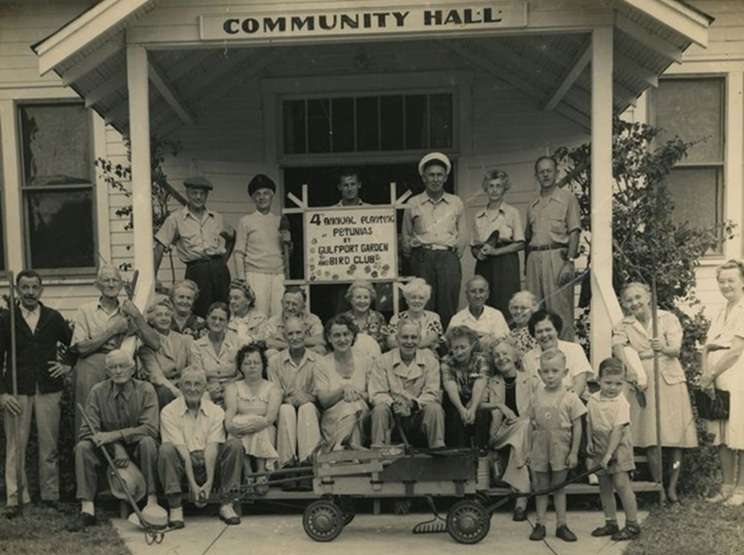
Photo courtesy of Gulfport Arts & Heritage
Councilwoman Christman
Christman won a seat on the Gulfport City Council in the November 1946 election. The mayor appointed Christman to serve with GPD while she sat as a council member. She regularly reported to other council members about GPD activities in the small, three-person department.
Christman also assumed a leading role in Gulfport’s first-ever Gay Nineties Festival. Beginning in the 1920s, many communities held similar Gay Nineties celebrations that included old-fashioned costumes, circus performances, vaudeville acts, and barbershop quartets.
She took on a lead role in planning for this January 1948 event. As part of the celebration, men in Gulfport were encouraged to grow handlebar mustaches, reminiscent of the 1890s.

Photo courtesy of Gulfport Arts & Heritage
Christman ran for another one-year term on the city council in 1948. Archie Tabor challenged her, and won the Nov. 16, 1948 election. Although Christman lost the election, she continued to receive appointments to work on “special cases” for GPD.
In December 1950, council members revised municipal ordinances and police policies. As part of this process, they planned to confer full police powers on Christman. Edna and her husband moved to a home on Clinton Street South in the early 1950s. A 1953 city directory referred to her as working for GPD.
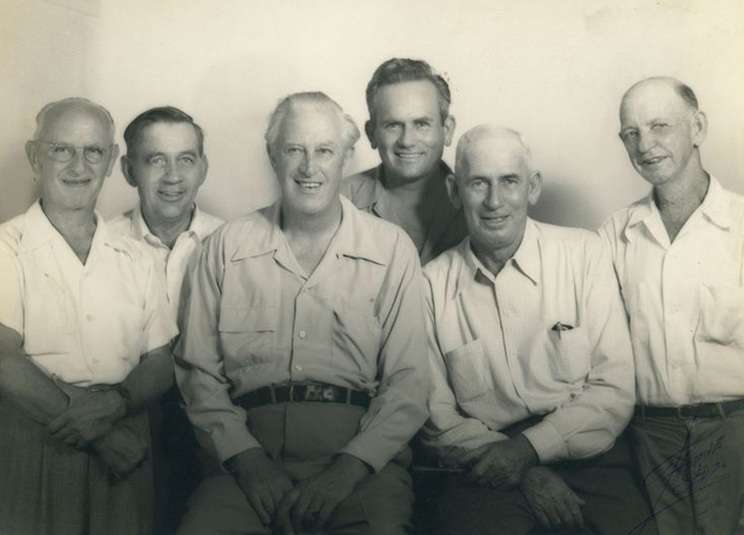
Photo courtesy of Gulfport History Museum
New Political Opportunities
As Christman continued her patrols along Gulfport Beach, other women assumed leadership roles in South Pinellas communities.
Margaret Ready, a resident of Belle Vista Beach [part of present-day St. Pete Beach], joined that municipality’s commission in 1950. Ready also served as mayor of Belle Vista from late 1955 until May 1956. Her husband, Thomas, had served as chief medical officer for the Veterans Administration facility when it was located at the Don CeSar Hotel.
Virginia Neel won a seat on the St. Petersburg Beach City Commission in May 1953. She became the first female commissioner in that city’s history. This municipality later consolidated with Belle Vista Beach, Don CeSar Place, and Pass-a-Grille to create the city now known as St. Pete Beach.
In December 1955, voters in Redington Beach elected Olive Rowland as the town’s first female commissioner. She received more votes than any other candidate. During a town meeting, Rowland’s peers selected her as Redington Beach’s first female mayor on Jan. 10, 1956.
During her two-year tenure, Rowland oversaw the creation of the town’s police and fire departments. A graduate of the University of Alabama’s law school, Rowland still encountered regular press reports that referred to her as “Mrs. George A. Rowland.”
In a Nov. 16, 1956 article in the St. Petersburg Times (now Tampa Bay Times), Rowland was referred to as a “lady-mayor” during a baking contest. The jurors pronounced her guilty of being the “best orange-cake baker in the St. Petersburg area.”
Political Empowerment
In the seven decades since Christman’s passing, numerous women have assumed positions of civic and public safety leadership in the Tampa Bay region. After the 1950s, the first notable wave occurred during the 1970s.
Patricia Louise Bailey-Snook gathered signatures to get on the ballot for the Pinellas Park City Council in 1972. She told a St. Petersburg Times reporter in December 1972 that “I hope I can straighten the boys up a little bit.” She won a council seat in the March 1973 election.
Bailey later served as Pinellas Park’s vice mayor and mayor before winning a seat in the Florida House of Representatives from 1982 to 1984. She returned to the city council from 1987 until 2008. In 2000, she married her second husband, John Snook. Bailey-Snook passed away in December 2014.

Photo courtesy of Pinellas Memory
Jeanne Malchon became the first woman to serve on the Pinellas County Commission. Winner of St. Petersburg’s “Outstanding Citizen” award in 1963, she served as president of the Florida League of Women Voters from 1969 to 1971.
Civic Leadership
Voters in St. Petersburg elected Corinne Freeman as that city’s first and only female mayor in March 1977. In that transitional election, residents also elected two other women to the city council: Sally Wallace and Betty Finley. Freeman served as St. Petersburg’s mayor from April 1977 until 1985.
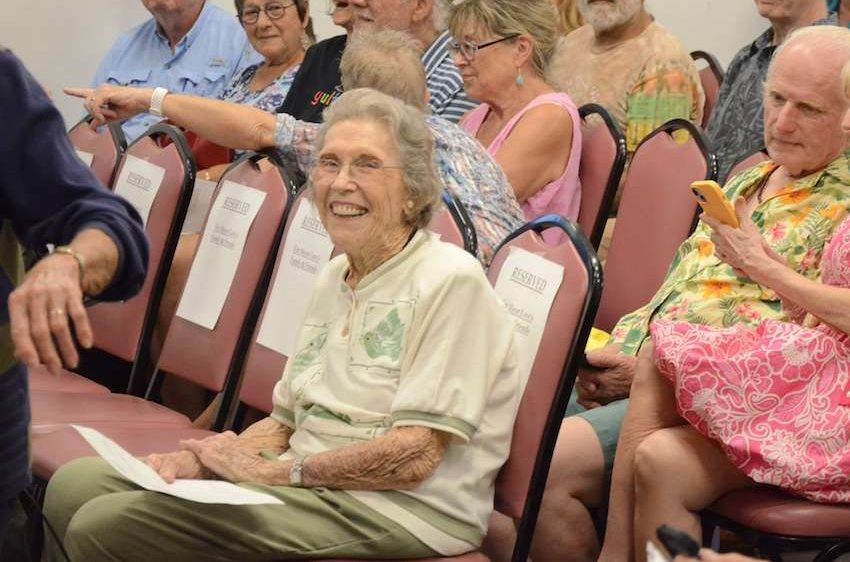
Photo by Cameron Healy
Yvonne Johnson ran for Gulfport City Council in 1972.
“I was tired of the crap going on with the council,” Johnson told The Gabber Newspaper in July 2024. “I ran and was elected for the council with the most votes up to that point.”
She served on council from 1972 to 1984. Later, she served as Gulfport’s first female mayor from 1985 to 1987.
“There were some times where I wish I had never thought of being on the Council, but I’m glad I was,” Johnson said.

Photo by Cameron Healy
Johnson, 96, attended the first meeting of Gulfport’s first all-female city council on April 1, and watched Karen Love sworn in as Gulfport’s second female mayor.
Mayor Love and the new council will have many important challenges to ahead of them. As Gulfport and its residents move forward, recovering from the aftermath of last year’s hurricanes, the examples of leadership by Christman and from others offer guidance.
The Gabber Newspaper? We Go There
In 1968, our founder, George Brann, started The Gabber Newspaper, then called the Gulfport Gabber, to hold Gulfport City Council accountable. Read more of our city council coverage, and learn about our policies on reporting, fact-checking, and funding.
